If you’re sitting Edexcel GCSE Business (1BS0) in summer 2026, the difference between a grade 7 and a grade 9 isn’t how much content you know — it’s how cleanly you handle the topics where everyone else loses marks.
This guide breaks down the six topics where Edexcel examiners report consistently call out poor candidate performance, and shows you exactly how to answer each one. Every technique here is drawn from Edexcel’s published examiner reports between 2019 and 2024 — so you’re learning from what real markers actually penalise, not from generic revision advice.
Quick answer: What are the hardest topics in Edexcel GCSE Business?
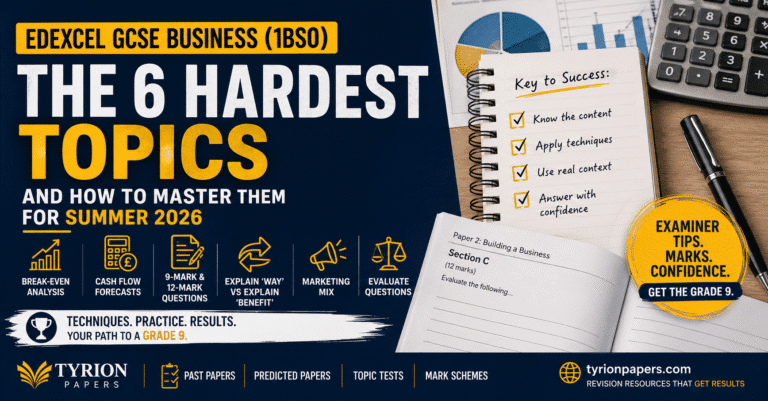
The six hardest topics in Edexcel GCSE Business 1BS0 are: break-even analysis with changing variables, cash flow forecasts, the 9-mark extended-writing questions, the difference between “explain a way” and “explain a benefit” questions, the marketing mix in unfamiliar contexts, and the “evaluate” command word in Section C of Paper 2. Each one has a specific technique examiners reward — and a specific trap they consistently penalise.
Quick recap: the Edexcel GCSE Business (1BS0) exam structure
Edexcel GCSE Business has two papers, each 1 hour 45 minutes long (paper timings were extended from 1hr 30 in 2023) and worth 90 marks. Each paper is 50% of your final grade.
- Paper 1 (1BS0/01) — Investigating Small Business. Covers Theme 1: enterprise, spotting a business opportunity, putting a business idea into practice, making the business effective, and understanding external influences.
- Paper 2 (1BS0/02) — Building a Business. Covers Theme 2: growing the business, making marketing decisions, making operational decisions, making financial decisions, and making HR decisions.
Both papers have three sections: Section A (multiple-choice and short-answer questions, no case study), Section B (case-study based, mid-length answers) and Section C (case-study based, extended writing including the dreaded 9-mark and 12-mark questions). From 2023, case studies appear in a separate source booklet so you can keep them open while answering.
Topic 1: Break-even analysis with changing variables
Why students lose marks
Most candidates can recite the formula: break-even = fixed costs ÷ (selling price − variable cost per unit). The trap appears when the question asks what happens to break-even when one variable changes — for example, “the business decides to lower its selling price by £2 per unit. Calculate the new break-even level of output.”
Edexcel’s June 2023 examiner report flagged this directly: candidates remembered the formula but couldn’t recalculate when the variables shifted. Many wrote down the original break-even, then stopped — scoring zero on a 2-mark question they should have walked.
How to crack it
- Read the question twice. Identify which variable has changed and what the new value is.
- Plug the new value into the formula. Don’t try to find a shortcut — recalculate the entire break-even level from scratch.
- Write the final answer on the answer line. A correct answer scores 2 marks automatically. Workings are only checked if the answer line is wrong.
- If asked for the change, subtract the new break-even from the old one and state the difference clearly: “The break-even level of output has increased by 50 units.”
Don’t write down the formula unless it helps you structure your work — there are no marks for it. Don’t round unless the question explicitly asks for “to 2 decimal places”, because Edexcel engineers calculation questions to give whole-number answers.
Topic 2: Cash flow forecasts
Why students lose marks
Cash flow questions look easy until the column maths goes wrong in one row, and the error cascades through the whole forecast. Common mistakes: confusing closing balance with net cash flow, forgetting to bring forward the opening balance from the previous month, and treating cash inflows and outflows as if they happen in the same column.
The deeper problem is conceptual. Students often can’t explain why a negative closing balance matters to a small business — which is exactly what the follow-up “explain” question always asks.
How to crack it
Memorise this sequence and run through it for every column:
- Total inflows (sum of cash receipts for the month)
- Total outflows (sum of cash payments for the month)
- Net cash flow = inflows − outflows
- Opening balance = closing balance of the previous month
- Closing balance = opening balance + net cash flow
For the conceptual follow-up, link a negative closing balance to specific consequences: the business may not be able to pay suppliers, leading to lost trade credit; or it may have to take an overdraft, increasing interest costs; or it may delay wage payments, reducing employee motivation. Two linked consequences per point — that’s the structure that scores 3 out of 3 on every “explain” question.
Topic 3: The “Explain one way” versus “Explain one benefit” trap
Why students lose marks
This is the single most penalised mistake in Edexcel GCSE Business — and it appears in nearly every examiner report from 2019 to 2024.
“Explain one way” asks for a process — how something happens. “Explain one benefit” or “Explain one drawback” or “Explain one impact” asks for an effect — what happens as a result.
The trap: students answer a “way” question with effects (“this leads to higher revenue and more profit”). Examiner reports note this consistently scores zero marks for that part of the answer, regardless of how well-written the rest is.
How to crack it
Underline the command word before you write a single word of answer.
If the question asks for a “way” or “method”, explain the process. Use sequencing words: “first the business would…”, “this then allows them to…”, “as a result, they are able to…”.
If the question asks for a “benefit”, “drawback” or “impact”, explain the effect. Identify the effect in the first sentence, then develop with two linked strands of consequence.
Don’t repeat the question stem at the start of your answer (“One way that the business could improve…”). Examiner reports specifically flag this as a waste of time that scores no marks.
Topic 4: The 9-mark and 12-mark extended-writing questions
Why students lose marks
The 9-mark questions in Section C are the biggest single grade decider in this qualification. They require the full AO1, AO2, AO3 trio: knowledge, application to the specific case-study business, and developed analysis.
Edexcel’s reports state plainly: generic answers cap at around 4 marks regardless of how well-written. If the case study is about a bakery and your answer references “a business” or “the company”, you’re already losing marks. Examiners want you to use the actual business name, the actual products, the actual context.
How to crack it
Use this structure for every 9-mark question:
- Point (first paragraph): State the relevant business concept clearly.
- Application: Link it directly to the case-study business using its name, product, or specific situation.
- Analysis: Develop a chain of three logical consequences. Use connectives — “this means”, “as a result”, “therefore”, “leading to”.
- Second paragraph: Repeat the same structure with a second, different point.
For 12-mark questions, the structure is the same but you add a brief judgement at the end — typically one sentence weighing your two points and choosing which is more important for this specific business in this specific context.
Three pages of writing including at least one reference to numerical data from the case study, where relevant. That’s the standard.
Topic 5: Marketing mix in unfamiliar contexts
Why students lose marks
The four Ps (product, price, place, promotion) are easy to memorise. Applying them to a completely unfamiliar business — say, a B2B firm selling industrial cleaning chemicals, or a non-profit running a charity shop — is what trips up the majority of candidates.
The most common mistake: defaulting to retail examples. Students learn marketing mix through familiar consumer brands and freeze when the case study is about a wholesaler, a service business, or a B2B firm.
How to crack it
Build a mental map of how each P adapts across business types:
- Product: physical goods → service quality → custom solutions for B2B
- Price: retail pricing strategies → value-based pricing for services → contract pricing for B2B
- Place: physical store → online platform → direct sales force for B2B → wholesale distribution
- Promotion: advertising → personal selling for high-value B2B → trade publications → digital/SEO for service businesses
For every case study, ask: who is the customer (consumer or another business)? What’s the product type (good, service, hybrid)? What’s the price range (low-cost mass market, premium, contract-based)? Then choose marketing-mix examples that fit, not examples you memorised about Apple or Tesco.
Topic 6: The “evaluate” command word in Paper 2 Section C
Why students lose marks
“Evaluate” is the highest-tier command word in GCSE Business and the one students most often misread. It doesn’t mean “describe both sides”. It means “weigh up the arguments and reach a justified judgement.”
The standard student response gives advantages on one side, disadvantages on the other, then writes “in conclusion, the business should consider both sides.” That’s a Level 2 answer — a 6 or 7 out of 12. Level 4 (full marks) requires a sustained judgement that names a winner and explains why for this specific business in this specific context.
How to crack it
Plan a “winner” before you write. Decide which side of the argument is stronger for the business in the case study, and build your answer to support that conclusion.
Structure:
- Two arguments for the position you’ll defend, with full case-study application.
- One counter-argument against it, fairly presented.
- Judgement: explicitly state your decision (“Based on this, the business should…”) and justify it using a specific feature of the case-study context — the size of the business, its current cash position, the nature of its market, or the time frame.
Examiner reports are crystal clear: the candidates who write a true judgement with a specific reason hit Level 4. The candidates who write a balanced summary do not.
How to put this into practice for summer 2026
Reading about technique and applying it under exam pressure are different skills. The students who consistently get grade 9 in Edexcel GCSE Business spend their final eight weeks doing three things:
- Past papers under timed conditions. Every paper from 2019 to 2024, marked against the official mark scheme. Pay attention to where you drop marks — patterns will appear within three or four papers.
- Examiner report drills. After each past paper, read the corresponding examiner report. The reports tell you exactly what real markers want, in their own words. They’re free on Pearson’s website and worth more than any revision guide.
- Predicted papers in the final weeks. Past papers are predictable once you’ve done them all twice. Predicted papers expose you to unseen case-study contexts that force you to apply technique without relying on memory.
Predicted papers for Edexcel GCSE Business 2026
Tyrion Papers’ Edexcel GCSE Business 2026 predicted papers are designed by tutors who’ve analysed every paper from 2019 to 2025 to identify the topics, command words, and case-study styles most likely to appear in summer 2026. Two full predicted papers (Paper 1 and Paper 2) come with mark schemes and worked solutions for £16.
Get the Edexcel GCSE Business 2026 predicted papers →
Try a free predicted paper sample →
Frequently asked questions
What is the structure of Edexcel GCSE Business?
Two written papers, each 1 hour 45 minutes long and worth 90 marks. Paper 1 covers Theme 1 (Investigating Small Business), Paper 2 covers Theme 2 (Building a Business). Each paper has three sections: Section A (multiple-choice and short-answer), Section B (case-study based), Section C (extended writing including 9-mark and 12-mark questions).
What is the difference between “Explain one way” and “Explain one benefit”?
“Explain one way” asks for a process — how something happens. “Explain one benefit” asks for an effect — what happens as a result. Edexcel examiners report that students consistently lose marks by finishing “way” answers with effects like “this leads to higher revenue”, which scores zero for that part of the answer.
How do you answer a 9-mark question in GCSE Business?
Two developed paragraphs, each with a point, application to the case-study business, and a chain of three logical consequences. Generic answers cap at around 4 marks — case-study application using the actual business name and context is essential.
How do you calculate break-even?
Break-even level of output = fixed costs ÷ (selling price per unit − variable cost per unit). When a variable changes, recalculate from scratch with the new figure. Write the final answer on the answer line — correct answer scores 2 marks automatically.
What grade do you need for a 9 in Edexcel GCSE Business?
The grade 9 boundary in Edexcel GCSE Business typically falls between 78% and 84% depending on the year. Pearson Edexcel publishes grade boundaries on results day each August.
Do I need predicted papers if I’ve done all the past papers?
Past papers tell you what Edexcel has asked. Predicted papers expose you to fresh case-study contexts and unseen scenarios you haven’t already memorised, which is exactly the situation you’ll face on exam day. Most grade 9 students use both.
For Edexcel GCSE Business past papers, mark schemes, topic tests, mock paper sets, and exam marking services, visit tyrionpapers.com — the home of cheap, reliable revision resources for GCSE, IGCSE, AS and A Level students.