Looking for OCR GCSE Maths 2026 papers and answers? You can find available OCR revision resources through the OCR section at Tyrion Papers. Start by checking your Foundation or Higher tier, the examination series and the paper number. Then choose a question paper and its matching answers so you can practise, review your working and decide what to revise next.
OCR GCSE Maths 2026: choose Foundation or Higher correctly
| Course / paper | What to check |
|---|---|
| Foundation J560/01, /02 and /03 | Papers 1 and 3: calculator. Paper 2: non-calculator. |
| Higher J560/04, /05 and /06 | Papers 4 and 6: calculator. Paper 5: non-calculator. |
| Series and answers | Match the year, June or November series, tier and component on both files. |
OCR numbering differs from Edexcel and AQA. A Higher student should not choose Paper 1 simply because it is the first exam in a set. Confirm your entry with your teacher before downloading. For formula sheets and current assessment instructions, check the paper cover and OCR guidance.
Why use recent OCR maths papers for revision?
A full paper tests how well you connect methods when the topic is not announced in advance. You may know a percentage method in a topic exercise but struggle to identify it in a longer problem. A timed attempt also shows whether you are spending too long on a single question or leaving straightforward marks unfinished.
Recent papers can support preparation for school mocks and later examinations. Keep older papers in your revision plan too: the value comes from the methods you learn, rather than the date printed on the cover. Check which 2026 resources and matching answers are available through Tyrion Papers before choosing a set.
Foundation and Higher: useful areas to practise
- Number and proportion: fractions, percentages, ratio, units and estimation. Write what the question asks you to find before calculating.
- Algebra: substitution, equations, sequences and graphs. Higher students should also practise connecting more demanding algebraic methods.
- Geometry and measures: label diagrams and identify which lengths or angles you actually know.
- Statistics and probability: read scales, totals and conditions carefully. Explain conclusions in the context given.
This is a revision checklist, not a forecast of questions. Use the full course specification and your own error log to choose priorities.
A short example: check what your answer represents
A £60 item is reduced by 15%. The reduction is 0.15 × 60 = £9, so the new price is £51. Giving £9 answers a different question. After marking, record whether your error was finding the percentage or interpreting the result. This is an original teaching example, not an extract from a 2026 examination.
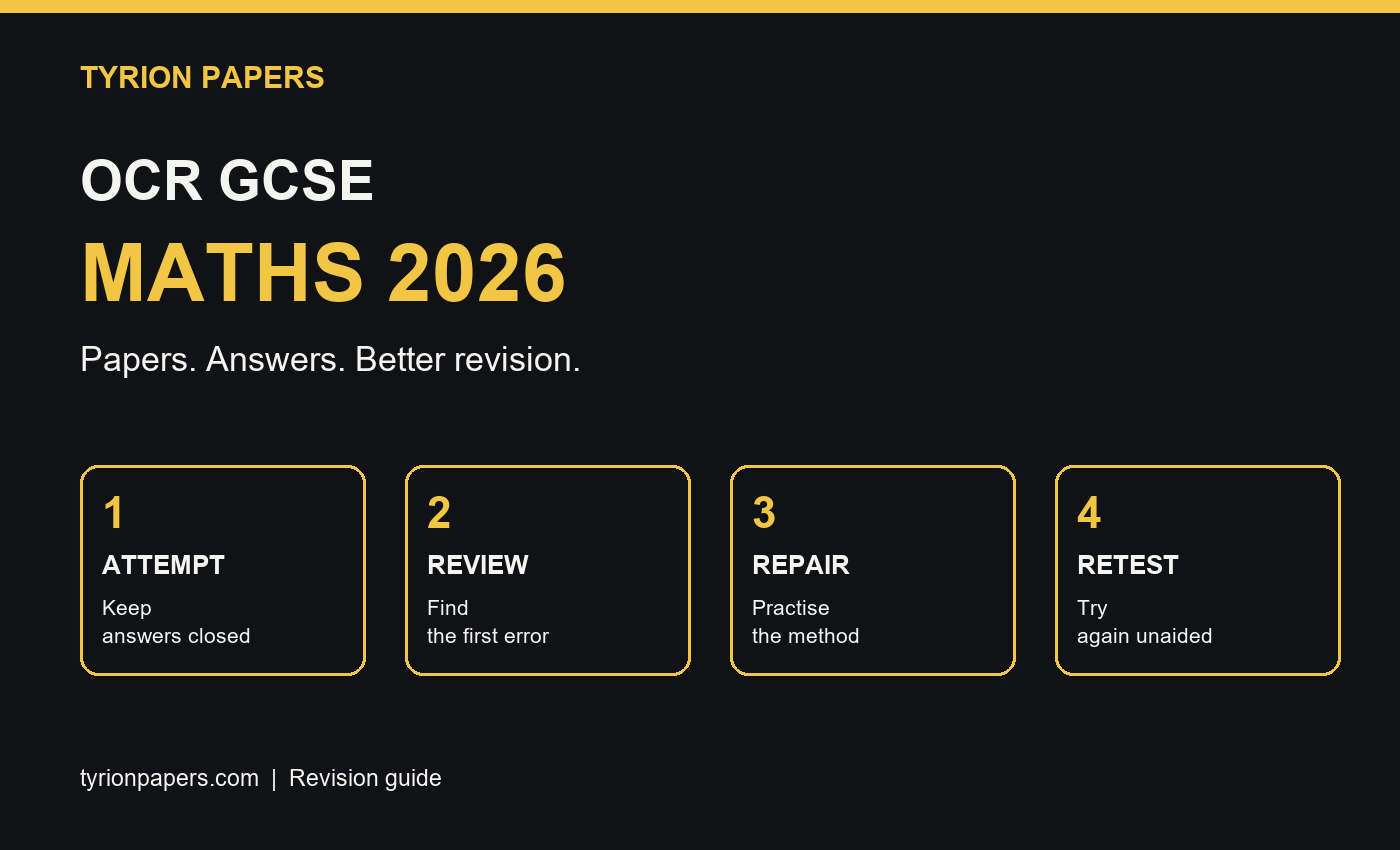
How to use papers and worked answers effectively
- Attempt the paper with the permitted equipment and keep the answers closed.
- Review your method, including incomplete working, rather than checking only final numbers.
- Choose three weaknesses and practise shorter questions on those skills.
- Retry the missed questions without notes, then attempt a different paper.
For the non-calculator paper, practise written arithmetic and fraction manipulation. For calculator papers, estimate first and keep unrounded values until the final step. Where a worked answer is independently produced, use it as an explanation; do not assume it is an official OCR marking document.
Where to get OCR GCSE Maths resources
Available papers and revision resources can be obtained from tyrionpapers.com. Visit the OCR resource section, choose GCSE Maths and check the file contents. If the exact year, tier or paper you need is not shown, use the site’s contact details to ask about availability.
Frequently asked questions
Which OCR GCSE Maths paper is non-calculator?
Foundation Paper 2 and Higher Paper 5 are non-calculator. The first paper at each tier permits a calculator.
Can I use June papers to revise for a November resit?
Yes, papers from the correct specification and tier can be useful practice. A June paper is not the November paper, and it does not predict its exact questions.
Are all downloadable answers official mark schemes?
Check the resource description. A mark scheme and an independently written worked solution serve different purposes; choose the matching document for the paper you attempt.