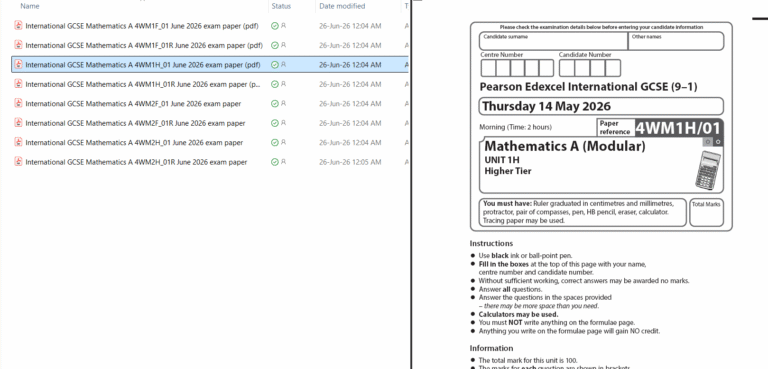
Looking for Edexcel IGCSE Maths modular past papers 2026? Use the Edexcel IGCSE resource finder and choose Mathematics A Modular at your entered tier. Check the unit code as well as the year: modular Mathematics A uses different assessments from the linear Mathematics A course.
Quick answer: Modular Mathematics A has Unit 1 and Unit 2 at Foundation or Higher tier. Match your unit, tier, exam series and regional version before selecting a paper. A resource labelled simply “IGCSE Maths Paper 1” may belong to another route.
Which modular Maths paper code should you choose?
| Tier | Unit 1 | Unit 2 |
|---|---|---|
| Foundation | 4WM1F/01 | 4WM2F/01 |
| Higher | 4WM1H/01 | 4WM2H/01 |
The specification gives a two-hour, 100-mark assessment for each unit, with calculators permitted. The cash-in codes are 4XMAF for Foundation and 4XMAH for Higher. Confirm your entry with your centre and use Pearson’s official modular Mathematics A specification for the full assessment rules.
Modular and linear Mathematics A are different routes
Linear Mathematics A resources are commonly labelled 4MA1, with paper names such as 1H, 2H, 1F and 2F. The modular route uses unit assessments. Overlapping topics can make a question useful for extra practice, but that does not make a linear paper a complete modular mock. For a realistic full attempt, match the course and unit on your entry.
Find the right 2026 resources
- Open the Edexcel IGCSE resource finder and locate the modular Mathematics A collection.
- Select Foundation or Higher to match your entry.
- Check Unit 1 or Unit 2 and the listed 2026 exam series.
- Check the standard or regional R version. Regional papers are alternative versions, not a different tier.
- Read the contents of the selected option. A mark scheme is not the same as a fully explained worked solution.
If your centre is preparing you for a later exam series, recent papers can help you practise the format. They do not predict which questions will appear next.
Use a modular paper to plan your next week
After a timed attempt, divide the mistakes into three groups: methods you have not learned, methods you know but applied incorrectly, and questions you misread. Choose a different repair for each group. Relearn the first, practise a small set for the second, and annotate the key quantities and command words for the third.
For instance, if a percentage question asks for the original price, multiplying the final price by the percentage reduction answers the wrong question. Write an equation linking the original and final amounts before calculating. The useful revision target is recognising the relationship, not repeating calculator operations.
What to record when marking
Keep the paper code, series, first-attempt score and the date of your attempt. Add two or three methods to revisit. When you return to the paper, label that score as a repeat attempt so you can distinguish remembered answers from independent progress. Use a fresh problem to check whether the improvement transfers.
Frequently asked questions
Can I mix Foundation and Higher papers?
They may share some skills, but choose your entered tier for full-paper practice and grade comparisons.
Is an R paper a resit paper?
R identifies a regional alternative in these listings. It does not by itself mean a resit. Check the complete code and series.
Can I add raw marks from different sessions to estimate a final grade?
Do not assume that is a valid final-grade calculation. Modular results use the awarding body’s rules and conversions; confirm the appropriate method with your centre.
Choose your tier and unit
Find Edexcel IGCSE Maths resources
Keep your course code beside you while selecting the resource so that your practice matches the qualification you are taking.