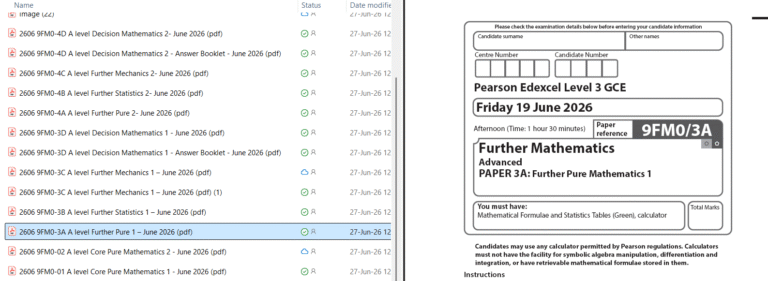
Looking for Edexcel A Level Further Maths 2026 papers and mark schemes? Start with the Edexcel AS and A Level resource finder, then choose Further Mathematics and check the year and paper option. This guide helps you select the correct 9FM0 papers and turn a timed attempt into useful preparation for your next assessment.
Quick answer: A Level Further Mathematics 9FM0 has two compulsory Core Pure papers and two optional papers. Check your school’s option combination before selecting resources. AS Further Maths 8FM0 and International A Level Further Maths are different courses.
Which Edexcel A Level Further Maths papers do you need?
| Paper | What to check |
|---|---|
| 9FM0/01 and 9FM0/02 | Core Pure Mathematics 1 and 2; both are compulsory. |
| Option 1: 3A, 3B, 3C or 3D | Further Pure 1, Further Statistics 1, Further Mechanics 1 or Decision Mathematics 1. |
| Option 2: 4A, 4B, 4C or 4D | The corresponding second option in each subject area; permitted combinations are restricted. |
Each assessment is 90 minutes and 75 marks. A permitted route uses either two different Option 1 subjects or an approved matching Option 1 and Option 2 pair. Follow your centre’s entry rather than buying every optional paper. Pearson’s official Further Mathematics specification explains the assessment and option rules.
Find the right 2026 resources
- Open the Edexcel A Level resource finder and locate Further Mathematics.
- Confirm A Level 9FM0, the 2026 series and the component code.
- Read the selected option to check whether it contains the question paper, mark scheme or additional worked solutions.
- Choose the papers you actually study. An all-options collection contains more than one student’s assessment route.
A mark scheme gives the marking points and accepted methods. A worked solution explains a route through the question in more detail. Do not assume the two labels mean the same thing; check the description of the resource you choose.
Make Core Pure practice useful
Begin with one timed paper and keep the answers closed. When you reach an unfamiliar question, write the information you can establish: a diagram, an equation, a matrix or a relevant identity. Afterwards, identify the first step where your reasoning stopped. That is a more useful revision target than simply recording that the entire question was difficult.
For example, suppose you correctly form a complex-number equation but make an error when expanding it. Your next session should focus on that algebraic step, followed by a fresh question using the same idea. Copying a complete solution without another attempt can disguise the weakness.
Review optional papers separately
Keep a separate error log for each option. Record the question, the method you chose, why it failed and one action for the next attempt. In a modelling question, that action might be defining the variables clearly; in a proof, it might be stating the assumption before manipulating an expression. Reattempt the question after a gap and then test the method on a different problem.
Frequently asked questions
Are 2026 papers suitable for 2027 revision?
They can provide recent practice when they match your course. Use them alongside your current specification, teacher guidance and a range of other questions. Completing one series does not establish readiness for the whole course.
Can I use AS Further Maths papers instead?
They can help with overlapping skills, but they do not replace the full A Level route. Select 9FM0 resources for full A Level paper practice.
Do I need every optional paper?
No. Ask your teacher or centre for your option combination and choose resources for those papers.
Start with your own paper combination
Browse Edexcel Further Maths resources
Choose a paper, attempt it independently and use the marking guidance to plan the next revision session.